
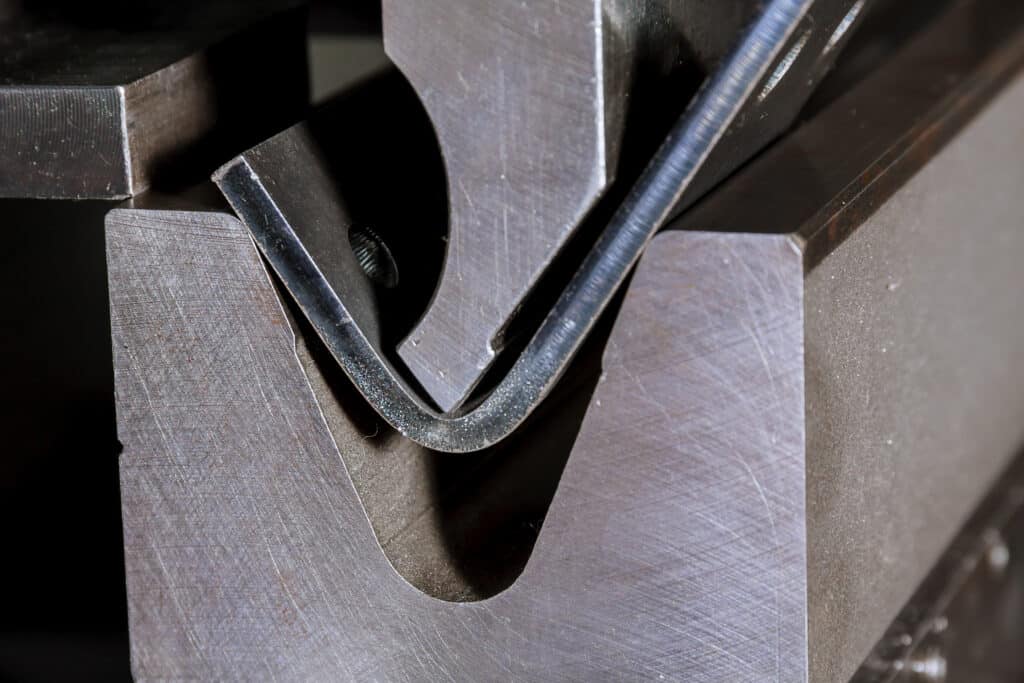
Many fabricated metal parts include bends that allow flat sheet metal to form brackets, enclosures, supports, and other structural components. One important concept involved in bending sheet metal is bend radius, which describes the inside curvature of the metal at the bend.
Understanding bend radius helps explain how sheet metal parts are formed and why fabrication drawings often include bend specifications.
Defining Bend Radius
In sheet metal fabrication, the bend radius refers to the radius of the inside curve created when a piece of metal is bent. Instead of forming a perfectly sharp corner, the metal curves slightly as it bends.
This curvature occurs because metal cannot fold infinitely without cracking or weakening. As a result, bends are formed with a gradual curve rather than a sharp edge. On fabrication drawings, the bend radius may be specified to indicate the expected curvature at the bend.
Why Bend Radius Exists
When sheet metal is bent, the material undergoes stress. The inside surface of the bend compresses while the outer surface stretches. Because of these material forces, bends naturally form with a curved profile rather than a perfectly sharp angle.
The bend radius helps distribute stress through the material and allows the part to maintain its strength during and after the forming process. If the bend radius is too tight relative to the material thickness, the metal may experience issues such as cracking or distortion.
Factors That Influence Bend Radius
Several factors affect the bend radius used in fabrication.
Material Type
Different metals behave differently when bent. Some materials are more flexible, while others are more rigid or brittle. These characteristics influence how tightly the material can bend without damage.
Material Thickness
Thicker materials generally require a larger bend radius than thinner materials. As thickness increases, more force is required to form the bend, and the metal must curve more gradually.
Part Design
The geometry of the part can also influence bend characteristics. Features such as holes, cutouts, or edges located near a bend may affect how the material behaves during forming.
Because of this, fabrication drawings often include information about both dimensions and bend locations.
Bend Radius in Fabrication Drawings
In many cases, bend radius is included as part of the specifications on a fabrication drawing. These specifications help communicate how a part is intended to be formed. Along with dimensions and tolerances, bend information allows fabricators to produce parts that match the required shape and fit within larger assemblies.
Clear drawings and specifications help maintain consistency when parts are produced in repeated runs.
Bend Radius and Fabricated Components
Many sheet metal components rely on bending to achieve their final shape. Brackets, supports, housings, and mounting components often incorporate multiple bends that allow flat material to form three-dimensional structures.
Because these parts frequently integrate into larger assemblies, consistent bend characteristics help ensure proper alignment and fit.
Fabricating Sheet Metal Components
Understanding fabrication concepts such as bend radius helps illustrate how sheet metal parts move from flat patterns to finished components ready for integration into larger equipment and structures.
At D+M Metal Products, we fabricate a wide range of sheet metal components that become part of larger products and assemblies. These parts often include bends that transform flat material into functional components used across many industries. If you’re looking for a fabrication partner for your next project, contact our team to discuss your requirements.