
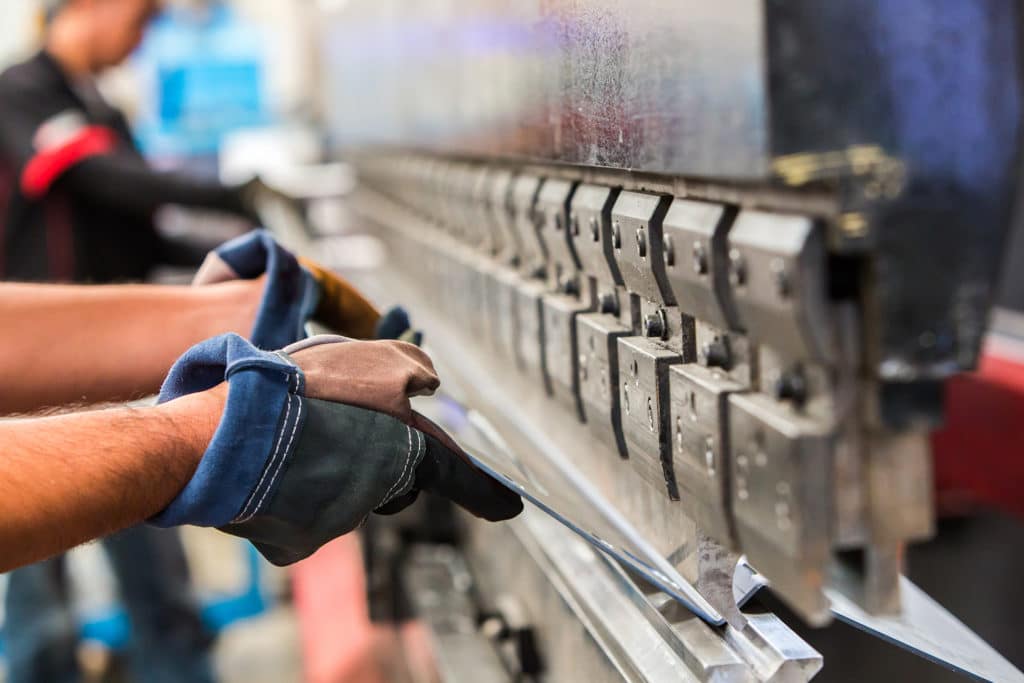
There are many processes involved in metal fabrication. We’ve talked about a number of them, including welding, laser cutting, blanking, and the post-fabrication processes involved in finishing. D+M Metal is proud of our experienced staff and the equipment we have invested in to extend our capabilities. Bending or press brake forming is another skill we have that our staff excels at. Let’s talk about what bending is and what it’s used to make.
What Is Bending?
Bending is a very common sheet-metal fabrication operation. It is often referred to as press braking, folding, die bending, flanging, or edging. This process uses equipment such as press brakes to introduce an angled shape into a piece of sheet metal. This can be a V shape, a U shape, or a channel shape.
In order to accomplish this, a press brake or other machine has to be able to apply force that exceeds a piece of metal’s yield strength. This creates a specified and permanent form in the material, overcoming both its tensile stresses and compressive stresses. The machine operator positions a piece of metal over a die block. The die block then presses the metal to form the shape. Because the metal’s residual stresses will cause it to spring back into its original position, the machine has to over bend it in order to produce the specified angle.
Types of Press Braking
There are three basic types of metal bending: air bending, bottoming, and coining which are based on the relationship of the end tool’s position to the thickness of the metal.
Air Bending
This is the most common and preferred method of bending. It is achieved by pressing a punch into a piece of sheet metal, forcing it into a V-die that is mounted on the bed of the press. In this type of bending there is less need for the punch to be pushed beyond the surface of the metal as well as less weight required. The distance between the punch of the sidewall of the V-die is greater than the thickness of the metal.
Bottoming
In this type of bending, the sheet metal is forced against the V opening in the bottom tool. Bottoming can produce greater accuracy and less springback, but more tools are required. Each bend angle, metal thickness, and material requires its own tool.
Coining
In coining the punch forces the sheet metal into the bottom die. This is similar to air bending but with 5-30 times the force. This causes permanent deformation to the entire sheet. Higher precision is possible with coining, but it’s a more expensive process and requires more tonnage than the other types of bending.
Each type of bending has its own advantages, and the one used is typically chosen due to the customer’s need for either greater accuracy or simplicity. Cost is an important factor. Simpler methods are more flexible and, most importantly, need fewer tools for getting a specific result, so they are less expensive.
D+M’s metal forming department is the second largest of all our departments, smaller only than our welding department. We can do brake press forming or bending up to 14 feet and 242 tons. We have the following equipment:
- 8 press brakes from 4 feet to 14 feet
- 1 folder/panel bender
- Bed length – 10 feet
- 4 Pem insertion machines
The skill of our operators is one major factor that sets D+M apart from the competition. Our staff has an average experience of 10 years in metal fabrication, and 50% of our customers have been with us for over 10 years. We think that says it all.
If you need bending or any other metal fabrication services, call us. We are ready to work with you on your next project.